
Review · NEW DELHI SAFARIS
Private 4-Day Golden Triangle Tour with Ranthambore Tiger Safari
The most unusual feature here is the way this Golden Triangle tour adds a real wildlife stop between the Taj Mahal and Jaipur. In four days, you move from Old Delhi’s crowded lanes to Mughal monuments, a government-run tiger reserve, and Jaipur’s pink sandstone palaces.
I like having one private driver for the whole route, and I like the freedom to adjust the sightseeing plan. Guides such as Aamir, Shan, Faisal, Sonny, and Isha are praised for clear explanations and friendly help. The main catch is simple: you spend long stretches in the car, especially between Agra, Ranthambore, Jaipur, and Delhi.
Quick points before you book
- A tiger safari breaks up the monument circuit: Ranthambore adds a chance to see wild Bengal tigers, though sightings are never guaranteed.
- Your car and driver remain with you: A private air-conditioned vehicle makes the long transfers easier and lets your group set the pace.
- Old Delhi gets a proper introduction: Jama Masjid, Chandni Chowk, and a rickshaw ride give you more than a quick roadside view.
- Monument tickets cost extra: Entrance fees are listed at about $180 per person, so the $230 tour price is not the final cost.
- The safari vehicle may change: A shared Jeep is preferred, but limited availability can mean a larger shared Canter.
- The itinerary can be adjusted: You can request monuments to be added, removed, or changed after booking.
Delhi begins with Jama Masjid and Old Delhi
Your first day starts in Old Delhi, where Jama Masjid gives you a strong opening lesson in Mughal architecture. Emperor Shah Jahan built the mosque between 1650 and 1656, during the same broad period associated with the Taj Mahal and Red Fort.
Allow about an hour here. The entry fee is not included, and appropriate clothing is important at a religious site. Your guide can provide the historical setting, while the size of the courtyard and minarets does much of the visual work.
From there, you move into Chandni Chowk. This is not a polished shopping street. It is a working market area with spices, dried fruit, silver jewelry, saris, and narrow lanes packed with small shops. I like this part because it shows Delhi as a living city rather than a string of monuments.
The included rickshaw ride lasts about 30 minutes. It is a short ride, but it lets you see how the old market district functions at street level. Expect noise, tight lanes, and plenty of movement. This is one of the tour’s best small touches, especially if you are visiting India for the first time.
More four-day safaris in India:
- 4 Day Golden Triangle with Ranthambore Tiger Safari Tour from Delhi
★ 5.0 · 110 reviews - From Delhi: 4-Day Golden Triangle & Ranthambore Tiger Safari
★ 4.8 · 47 reviews - 4 Days Group Camping Safari
★ 5.0 · 1,101 reviews
Red Fort, Qutub Minar, and Delhi’s grand avenues
The Red Fort follows, with roughly 30 minutes listed for the stop. That is enough for an outside look and a quick introduction, but not enough for a slow museum visit. The fort served as the Mughal emperors’ main residence in Delhi for nearly two centuries, until 1856.
The Red Fort and Lotus Temple are closed on Mondays. On those days, the plan substitutes Gurudwara Bangla Sahib for the Red Fort and Lotus Temple visits. Confirm the exact Monday routing before you set out, since the day can become crowded with Delhi sightseeing.
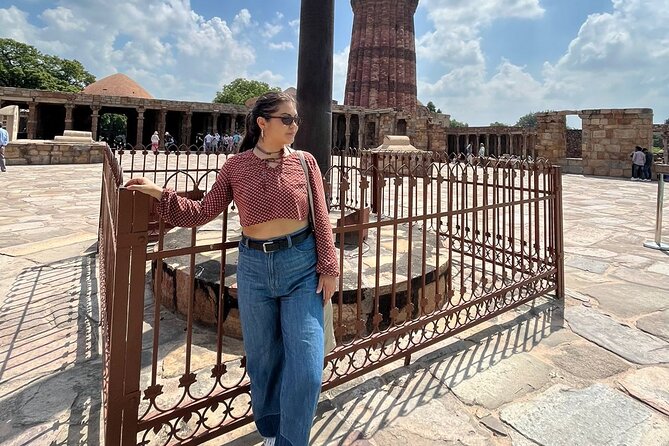
Qutub Minar deserves about an hour. This UNESCO site dates to 1193, when Qutub-ud-din Aibak founded the Delhi Sultanate. The tower’s carved exterior is the main attraction, and the guide helps explain the early Sultanate period and the monument’s design. Entry is extra.
The Lotus Temple is a short stop of around 30 minutes. Its white, flower-shaped design dates from 1986, and the building offers a quiet contrast to the traffic outside. India Gate and the government district add another change of mood. You pass Parliament House and Rashtrapati Bhavan, the President’s residence, before stopping at Agrasen Ki Baoli.
Agrasen Ki Baoli is a protected stepwell, and its 15-minute visit is brief. It works best as a quick architectural pause rather than a major attraction. The nearby government avenues can also be viewed from the vehicle, so ask your guide which stops allow you to walk and which are mainly drive-bys.
The Delhi to Agra transfer takes real time
After Delhi sightseeing, lunch is arranged at a nearby restaurant before the drive to Agra. The listed transfer time is about three hours, though traffic can change that.
This is where the tour’s private format earns its keep. You can stop briefly, ask questions, and travel with only your own group. Driver feedback often highlights comfort, water, and careful handling of Delhi’s chaotic traffic. Names associated with particularly well-liked service include Bilal and Amar.
You spend the night in Agra. The hotel choices depend on the package, with three-star, four-star, and possibly five-star options. Examples listed include Hotel Taj Vilas for the three-star option and Hotel Golden Tuli for the four-star option. If you choose the package without hotels, you arrange your own accommodation, with the first night still intended for Agra.
Sunrise at the Taj Mahal
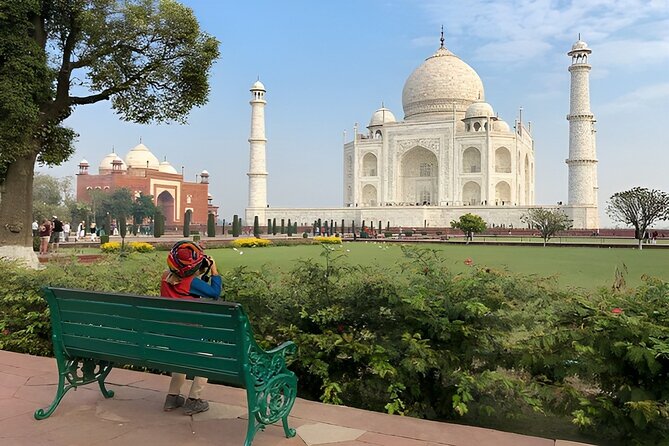
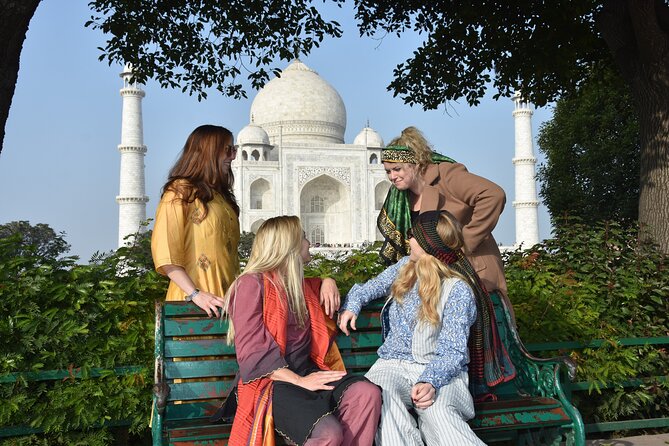
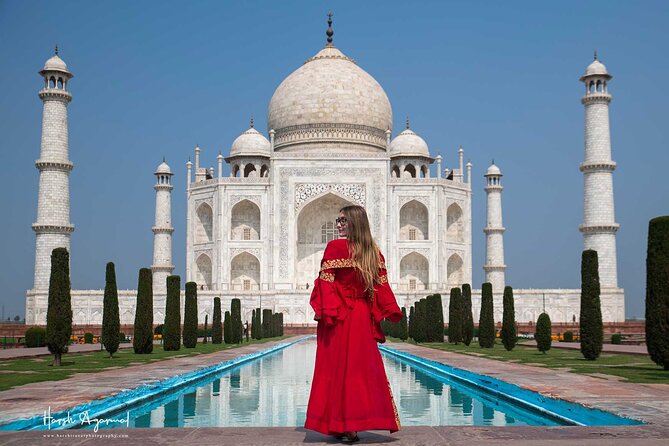
The second day begins early at the Taj Mahal. That early start matters because the monument is cooler and less harshly lit in the morning, and you have a better chance of enjoying its changing color and reflection across the grounds.
Plan about three hours here, including the guided visit inside. The Taj Mahal is a UNESCO World Heritage site and the emotional center of the tour. Your guide handles the monument ticket process and helps you move through the entry system, but the admission fee itself is not included.
Guides such as Shan are praised for turning the visit into a story rather than a list of dates. Small details about the building, its purpose, and its design can make the visit more memorable. You will also have time for photographs, though the guide may need to balance that with the group’s schedule.
The Taj Mahal is closed every Friday. If your tour begins on Thursday, the order changes to Delhi, Jaipur, Ranthambore, Agra, and Delhi so the Taj Mahal can be visited on a different day. This is an important booking detail, not a minor footnote.
A few more safaris around India worth a look
- Non-Touristic overnight Camel Safari
★ 5.0 · 526 reviews - Overnight Camel Safari – Sleeping under the Stars
★ 5.0 · 390 reviews - Adventure non touristic camel safari
★ 5.0 · 300 reviews - Overnight Desert Safari Tour Package
★ 5.0 · 255 reviews
Agra Fort before the road to Ranthambore
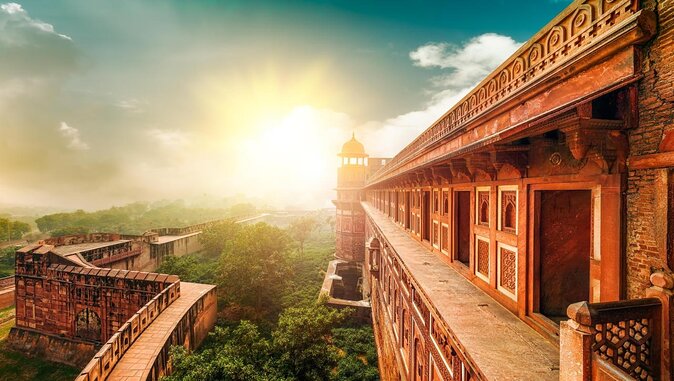
Agra Fort takes about an hour. This red sandstone complex is another UNESCO site, but it feels different from the Taj Mahal. Instead of a single symmetrical monument, you get a large fortified royal compound with halls, courtyards, and views connected to Mughal power.
A private guide helps you sort out the buildings and rulers without getting lost in a long sequence of names. I would not rush this stop, but the schedule gives you less time than the Taj Mahal. Wear comfortable walking shoes because the day combines early sightseeing with a long transfer.
After Agra Fort, you travel toward Ranthambore. The listed transfer time is roughly four hours, making this one of the tour’s most demanding road sections. Once you reach the national park area, you check into your hotel and have free time.
The three-star example is Ranthambore Tiger Resort or a similar property. A four-star option is available, depending on the package selected. One hotel dinner is included, along with three breakfasts across the tour.
Ranthambore safari: exciting, but not guaranteed
The safari begins early on the third day. You spend about two to three hours in Ranthambore National Park in a shared Jeep or Canter, accompanied by a government-appointed local guide.
The goal is to find wild Bengal tigers, but no responsible tour can promise a sighting. The appeal is the search itself: forest tracks, open areas, animal signs, and the possibility of seeing a tiger in its natural setting. The safari brings a very different kind of attention after two days of architecture.
Safari zones are assigned by the government according to availability. You do not choose the zone, and the zone can affect what you see. The operator tries to secure a shared Jeep, but there are limited vehicles. If one is not available, you may ride in a shared Canter, which carries more people.
The safari guide speaks English, but fluency can vary. You should expect basic explanations rather than the polished storytelling you may receive from your Delhi, Agra, or Jaipur guide. Keep expectations realistic and treat the safari as wildlife watching, not a guaranteed tiger photograph.
Jaipur arrives after another long transfer
After the safari, you travel to Jaipur and check into your hotel. The drive is listed at about three hours, though road conditions can change the timing. The rest of the day is free, which is useful after the early safari.
The three-star hotel example is 7 Apple view of Water palace or a similar property. Four-star and five-star options may be available depending on the package. The private driver remains an advantage here because you are not managing several separate transfers after a tiring morning.
Jaipur’s stepwell, fort, and lake palace
The fourth day begins with Panna Meena ka Kund, a stepwell near Amber. Give it about 20 minutes. Its geometric stairways make it a quick but photogenic stop, and it offers a quieter start than the major palace sites.
Amber Fort receives about two hours. This UNESCO-listed complex combines Rajput architecture, courtyards, gates, decorated halls, and broad views from its hill setting. The entry fee is extra. This is one place where a guide adds real value because the sequence of courtyards and palace spaces can blur together without context.
Jal Mahal follows with a 30-minute stop. The palace sits in Man Sagar Lake, and the usual visit is a view from the shore rather than an interior tour. It is a good place for photographs and a short pause between larger sights.
City Palace, Jantar Mantar, and Hawa Mahal
The City Palace takes about two hours. It served as Jaipur’s administrative and ceremonial center and now contains the Maharaja Sawai Man Singh II Museum. You see palace courtyards, royal objects, and decorative details that show Jaipur’s court culture.
Jantar Mantar is nearby and deserves its scheduled hour. Built in 1734 by Sawai Jai Singh II, it contains 19 large astronomical instruments. This is not just a collection of old stone shapes. The instruments were designed to measure time and track celestial positions, and the guide can make their purpose easier to understand.
Hawa Mahal is a 30-minute stop. The pink and red sandstone facade is one of Jaipur’s most recognizable sights, but the view from outside is often the main event on a tightly timed city tour. If you want more time inside, ask about adjusting the schedule.
Gaitore Ki Chhatriyan closes the day with carved royal cenotaphs and Rajput design. The half-hour visit gives you a quieter ending than the City Palace or Hawa Mahal. It is also a useful reminder that Jaipur is more than its most photographed facade.
The private car is the tour’s biggest practical advantage
This is a private tour for your own family or friends, not a large shared sightseeing group. The vehicle depends on party size:
- One or two people: a three-seat sedan such as a Toyota Etios or similar
- Three to five people: a six-seat wagon such as a Toyota Innova or similar
- Six to ten people: a ten-seat Tempo Traveler or similar
The driver stays with you through the route, while local guides join for sightseeing. This split works well. You get continuity on the road, but local help at the major monuments.
The tradeoff is the route itself. One visitor described the tour accurately as enjoyable but car-heavy. Delhi to Agra, Agra to Ranthambore, Ranthambore to Jaipur, and Jaipur to Delhi cover serious ground. On day four, arrival in Delhi is expected around 9 p.m., although an earlier or later return can be requested.
What the $230 price really covers
At $230 per person, the base price looks low for four days of private transport, local guides, three hotel nights, breakfasts, an Old Delhi rickshaw ride, and a safari. It becomes a different calculation once you add the listed monument entrance cost of about $180 per person.
That puts the advertised experience near $410 per person before any personal spending, depending on the hotel category and final ticket charges. Still, the package can offer fair value if you want one organized route and would otherwise need to arrange several drivers, hotels, guides, and the safari separately.
Ask exactly which hotel category you are receiving. The difference between three-star and four-star lodging matters more after long road days, when a comfortable room and a quiet evening can shape the whole experience.
Who will get the most from this tour
I would choose this for a first visit to northern India, especially if you want the major sights without arranging every transfer yourself. Families and small friend groups benefit most from the private car and flexible schedule.
It also suits anyone who wants more than the standard Delhi, Agra, and Jaipur circuit. Ranthambore changes the pace and gives you a chance at wildlife, though the safari vehicle, zone, guide language, and tiger sighting are all outside your control.
I would hesitate if you dislike early starts, long drives, or tightly packed sightseeing. Four days is enough to see the headline places, but not enough for slow mornings and long museum visits. This is a fast introduction, not a restful holiday.
Should you book it?
Book it if you want the Taj Mahal, Jaipur, Delhi, and Ranthambore in one private route, and you value having a driver and local guides already arranged. The strongest parts are the Old Delhi rickshaw ride, the early Taj Mahal visit, the flexible private format, and the careful service associated with guides such as Aamir, Shan, and Isha and drivers such as Bilal and Amar.
Think twice if the extra $180 monument cost changes your budget, or if you need guaranteed English fluency on safari. Check the Friday and Monday closures before booking, wear comfortable shoes, and accept that the road time is part of the deal. Cancellation is free up to 24 hours before the start time, but changes or cancellations inside that window are not refunded.
FAQ
How long is the tour?
The tour lasts approximately four days and includes three nights of accommodation.
Where does the tour start and finish?
Pickup is offered in New Delhi, and the fourth day returns you to Delhi at about 9 p.m. The exact pickup and return arrangements depend on the locations provided during booking.
Is the tour private?
Yes. The vehicle, driver, and sightseeing arrangements are for your own group. The Ranthambore safari itself is shared in a Jeep or Canter.
Are hotels included?
Yes, if you select an option that includes hotels. Three-star, four-star, and possibly five-star hotel choices are offered. A no-hotel option is also available.
Are meals included?
Three breakfasts are included, along with one dinner at the hotel in Ranthambore. Lunches and other meals are not listed as included.
Are monument entrance fees included?
No. Monument entry fees are listed separately at approximately $180 per person. Guides can assist with purchasing tickets at the sites.
Is the Taj Mahal open every day?
No. The Taj Mahal is closed on Fridays. If the tour begins on Thursday, the route changes so the Taj Mahal is visited on another day.
What happens if the tour falls on a Monday?
Red Fort and Lotus Temple are closed on Mondays. The itinerary substitutes Gurudwara Bangla Sahib for those visits.
Is a tiger sighting guaranteed?
No. The safari searches for wild Bengal tigers, but sightings are not guaranteed. The safari zone is assigned according to government availability.
What type of vehicle is used for the safari?
The operator tries to arrange a shared Jeep. If one is not available, you may ride in a larger shared Canter. The safari guide is English speaking, though fluency can vary.
Newest safaris around India
- Wild Life Jeep Safari Tour at Bannerghatta with Private Transfer★ 5.0 · 24 reviews
- Explore Bangalore’s Wild Side – An Exclusive Bannerghatta Safari!★ 5.0 · 10 reviews
- Sariska Tiger Reserve Assistance for Gypsy Private Safari Tickets★ 4.0 · 13 reviews
- Chambal River Safari★ 5.0 · 75 reviews
- Sanjay Gandhi National Park + Kenheri Caves + Lion Safari★ 4.4 · 19 reviews
- Sawai Madhopur: Ranthambore National Park Guided Jeep Safari★ 4.4 · 23 reviews
- Ranthambore National Park: Safari Ticket with Pickup Option★ 4.5 · 32 reviews
- Peeps Billions of Star Experience with Desert & Camel Safari★ 4.8 · 18 reviews
New Delhi Safaris, side by side.
4 Day Golden Triangle with Ranthambore Tiger Safari Tour from Delhi
Read our review →
Delhi Agra Jaipur Golden Triangle Multiday Trip with Safari
Read our review →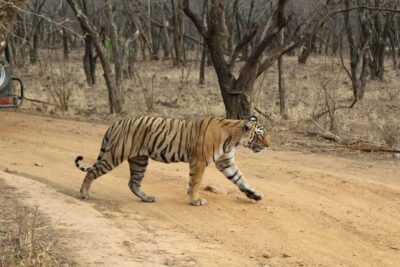
4-Day Golden Triangle & Ranthambore Tiger Safari
Read our review →
5 Day Golden Triangle, Safari, & Bird Sanctuary
Read our review →Lists this safari turns up in